The ageing retina and Methylene Blue
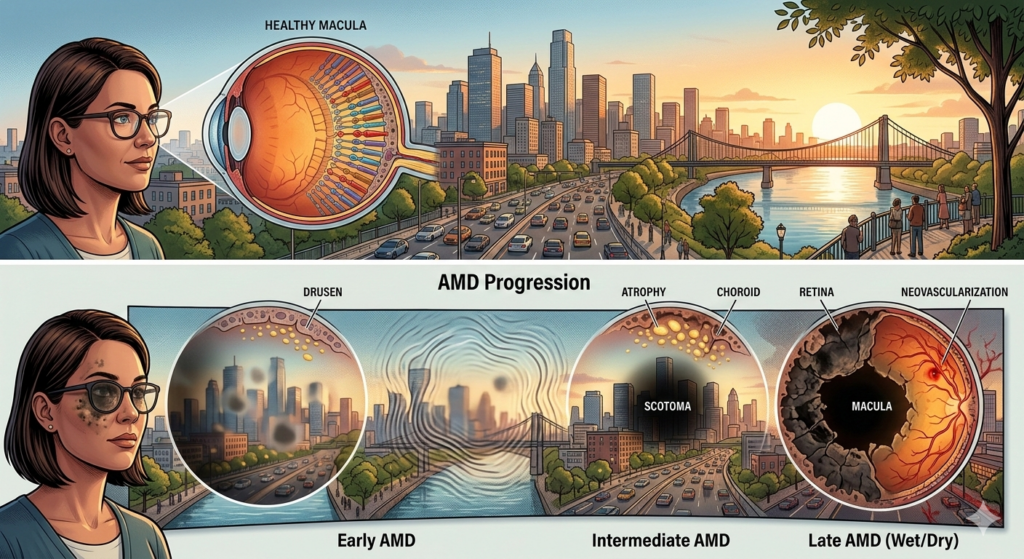
The eye is one of the body’s most metabolically demanding organs — and one of the most vulnerable to the twin threats of oxidative stress and mitochondrial dysfunction that drive ageing. Nowhere is this more consequential than in Age-Related Macular Degeneration (AMD), the leading cause of irreversible vision loss in people over 50. AMD destroys the central vision by progressively killing the light-sensitive cells of the macula — the tiny but critical region of the retina responsible for sharp, detailed sight.
At the heart of AMD’s progression is a familiar story: the mitochondria of the retinal pigment epithelium (RPE) — the vital support layer behind the photoreceptors — become damaged and dysfunctional. This triggers a cascade of oxidative damage, inflammation and cell death that slowly robs the eye of its ability to see clearly.
A 2024 scientific review described drugs that can restore mitochondrial health in the retina as “promising therapeutic avenues” for AMD — and Methylene Blue sits squarely in that category.
The research below summarises what science is discovering about Methylene Blue’s remarkable potential to protect eye cells, preserve vision and possibly slow the progression of AMD and related sight-threatening conditions.
A Note on the Research: The studies presented here are predominantly preclinical — conducted in animal models or cell cultures. While the evidence is highly encouraging and mechanistically compelling, human clinical trials specifically targeting AMD with Methylene Blue have yet to be conducted. As always, consult a qualified healthcare professional before making any decisions about supplementation or treatment.
IMPORTANT: Methylene Blue in liquid form should not
be used as eye drops.Consume orally.
Metabolic Shift and Mitochondrial Dysfunction: Why AMD and Methylene Blue are Inextricably Linked
Boia R et al. – Frontiers in Aging Neuroscience / PMC (2024)
This major review article identifies mitochondrial failure and an abnormal metabolic shift — where retinal cells abandon efficient energy production in favour of a wasteful, inflammation-driving alternative — as central to how AMD develops and worsens.
The authors specifically highlight Methylene Blue as one of the most promising agents for correcting these metabolic abnormalities.
By acting as a “jumper cable” that slots directly into the mitochondria’s energy-production chain, MB bypasses defects, helps transfer electrons to oxygen to form water, and counteracts the dangerous “Warburg effect” — a damaging energy-production detour seen in AMD-affected retinal tissue. The review also notes that MB reduces excess lactate secretion, which is a toxic byproduct of this malfunctioning metabolism.
In experimental AMD models, Methylene Blue has been shown to prevent the retinal cell death caused by mitochondrial toxins and protect against damage from elevated eye pressure — both processes directly relevant to macular degeneration.
Neuroprotective Actions of Methylene Blue and its Derivatives: The Optic Neuropathy Connection
Poteet E, Winters A et al. – PLoS One (2012)
This important study explored exactly how Methylene Blue delivers neuroprotection in the visual system, with a particular focus on optic neuropathy — the degradation of optic nerve function that is closely linked to both glaucoma and AMD.
The research confirmed that MB provides both behavioural and metabolic neuroprotectionagainst optic neuropathy by functioning as an alternative mitochondrial electron carrier — bypassing the damaged sections of the energy-production chain (Complexes I–III) that are typically implicated in retinal disease. Critically, MB was also shown to increase the activity of Complex IV (cytochrome c oxidase) — the final and most critical stage of the energy chain — while simultaneously reducing the production of damaging free radicals. This dual action of restoring energy while neutralising damage is what gives MB its particular power as an eye-protective compound.
Methylene Blue Protects Retinal Ganglion Cells from Cellular Senescence
Daudt DR, Mueller B, Park YH, Wen Y, Yorio T – Investigative Ophthalmology & Visual Science (2012)
Published in one of ophthalmology’s most respected peer-reviewed journals, this study provides compelling evidence that Methylene Blue can rescue the specific cells most vulnerable in AMD and glaucoma — the retinal ganglion cells (RGCs), whose progressive loss leads to irreversible vision damage.
Using primary rat retinal cells in controlled laboratory conditions, the researchers exposed RGCs to three distinct forms of cellular stress that mirror the damage seen in age-related eye diseases:
- Rotenone toxicity (mitochondrial energy failure — the same mechanism at work in AMD)
- Staurosporine (apoptosis — the programmed cell death that kills RGCs in AMD and glaucoma)
- Hypoxia (oxygen deprivation — a key driver of retinal ischaemia and vision loss)
In all three scenarios, Methylene Blue significantly protected the retinal ganglion cells, with survival rates improving by up to 1.9-fold compared with untreated cells. Even more significantly, MB was shown to preserve cytochrome c oxidase activity — the engine of cellular energy production — when cells were subjected to oxidative attack. The authors concluded that MB is a powerful neuroprotective compound and called for further testing of its potential as a treatment for optic neuropathy.
Methylene Blue Prevents Retinal Damage in Ischemic Retinopathy
Rey-Funes M, Larrayoz IM et al. – American Journal of Physiology – Regulatory, Integrative and Comparative Physiology (2016)
This study demonstrated that Methylene Blue can prevent the retinal damage caused by ischaemia — a reduction in blood supply and oxygen that is a significant contributing factor in advanced AMD and other sight-threatening retinal conditions.
Researchers found that MB acts directly on the retina’s nitrergic system — the network of signalling molecules controlled by nitric oxide (NO). When excessive NO is produced during ischaemic events, it acts like a poison to retinal cells. Methylene Blue effectively blocks this process, competing with NO for binding sites on a key enzyme and thereby protecting the retina from nitric-oxide-induced destruction. Critically, MB also helped restore the expression of PEDF (Pigment Epithelium-Derived Factor) — a naturally occurring retinal protector whose levels are markedly reduced in AMD patients — making this finding especially relevant to macular degeneration research.
Methylene Blue Prevents Retinal Damage Caused by Perinatal Asphyxia
Fernández JC, Peláez R, Rey-Funes M et al. – Frontiers in Cellular Neuroscience (2020)
While this study examined retinal damage caused by oxygen deprivation at birth, its findings have direct relevance to AMD because the cellular destruction mechanisms — and MB’s countermeasures — are strikingly similar to those seen in age-related retinal degeneration.
Using electroretinography (ERG) — the same technology used clinically to diagnose AMD and other retinal conditions — the researchers confirmed that ischemic damage caused significant defects in the retina’s electrical responses, including the a-wave (photoreceptor function) and b-wave (signal processing by inner retinal cells). Treatment with Methylene Blue prevented all of these functional deficits and dramatically reduced retinal cell death.
The mechanism? MB blocked the overexpression of iNOS (inducible nitric oxide synthase — a key driver of retinal inflammation), reduced the pathological growth of new, abnormal blood vessels (a hallmark of “wet” AMD) by suppressing VEGF, and simultaneously boosted the retinal protective factor PEDF. This combination of anti-inflammatory, anti-angiogenic and pro-survival effects mirrors almost exactly what researchers are trying to achieve in AMD treatment.
Methylene Blue Reduces Retinal Inflammation, Apoptosis and Oxidative Stress in Diabetic Retinopathy
Mai H, Liu C, Fu B, Ji X et al. – Alternative Therapies in Health and Medicine (2023)
This 2023 study offers the most recent and perhaps most clinically striking evidence yet for Methylene Blue’s retinal protective powers. Although focused on diabetic retinopathy — a retinal disease that shares many of the same oxidative and inflammatory drivers as AMD — its findings are directly applicable to macular degeneration research.
In both a live rat model and human retinal cell cultures, MB treatment significantly reduced all three primary drivers of retinal cell death:
- Reactive oxygen species (ROS) — the free radicals that destroy retinal cells
- Inflammation markers (IL-6, TNF-α, CRP) — the fire of cellular destruction
- Apoptosis (programmed cell death) — the irreversible end-stage of retinal damage
The key mechanism identified was MB’s activation of SIRT1 (Sirtuin 1) — a master regulator of cellular health and longevity that is known to be suppressed in both diabetic retinopathy and AMD. By switching SIRT1 back on, MB was able to restore mitochondrial function, cool inflammation, and prevent cell death in a dose-dependent manner. Given that SIRT1 activation is now recognised as a promising target for AMD therapy, this finding adds a powerful new dimension to Methylene Blue’s potential role in preserving vision.